
Need Help?
+91 94294 10291
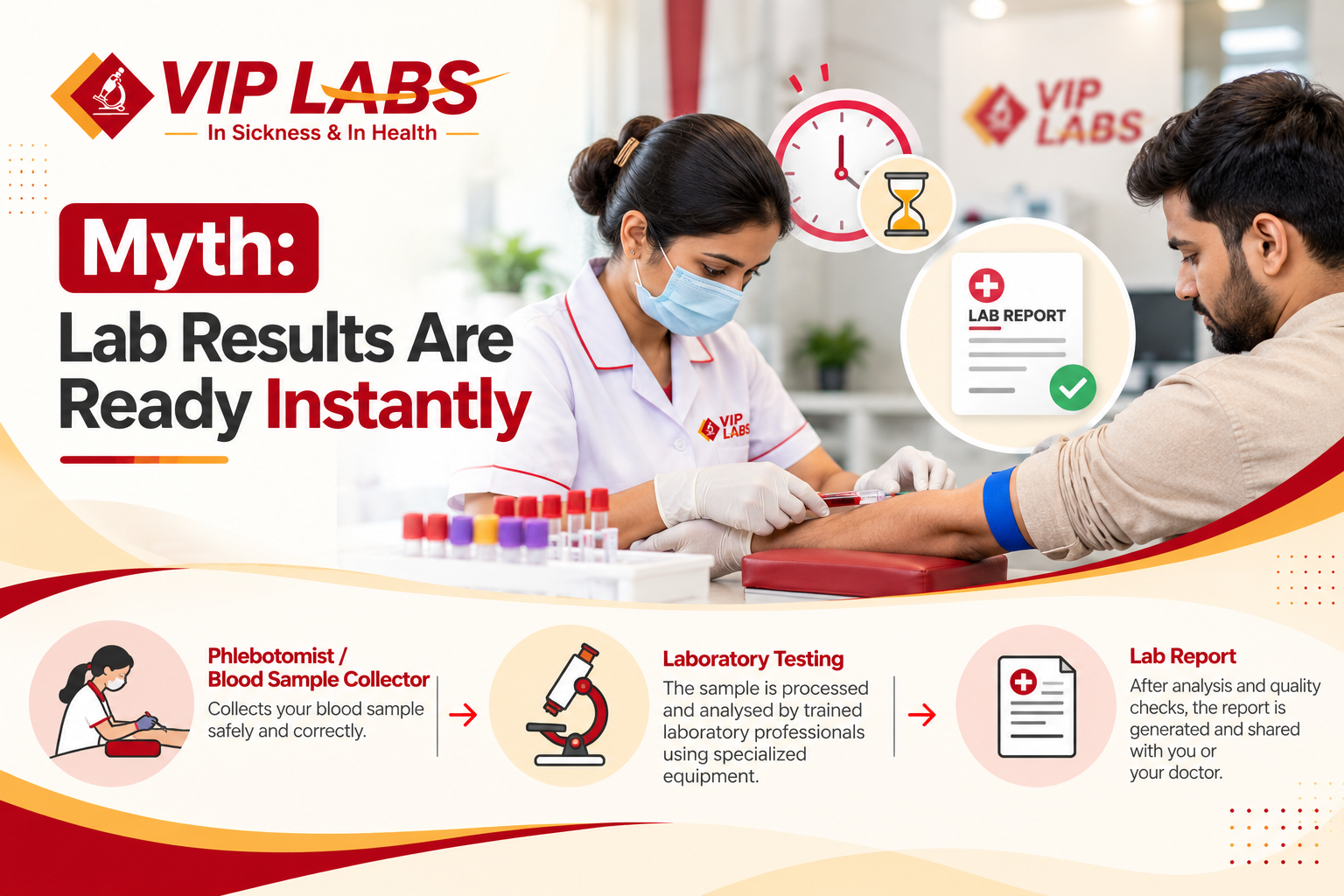
You give your blood sample, the phlebotomist collects the tubes, and you may naturally wonder, “When will my report be ready?”
Some people believe that once the blood sample is collected, the laboratory can immediately provide the result.
That is a myth.
Although some simple tests can have very short reporting times, not every laboratory test can be completed instantly. The time required depends on the type of test, sample processing, laboratory method, quality checks, and other factors.
A laboratory report goes through several steps before it is released. Therefore, sample collection time and report availability time are not always the same.
A laboratory report is not produced simply by collecting a blood sample.
After collection, the sample generally goes through several stages:
Sample Collection → Sample Processing → Laboratory Analysis → Quality Checks → Result Review → Report Generation
Each stage plays an important role in producing a reliable laboratory result.
The goal is not simply to provide the fastest possible report, but to provide a properly processed and reliable result within the expected turnaround time.
A trained phlebotomist or blood sample collector collects the required specimen using the appropriate collection tube.
The sample must be correctly identified and handled before testing.
Depending on the test, the specimen may need to be separated, centrifuged, prepared, or otherwise processed before analysis.
Different laboratory tests can have different sample requirements.
Laboratory professionals use appropriate instruments, reagents, and testing methods to analyze the sample.
A routine blood count, hormone test, vitamin test, and specialized investigation may all require different laboratory procedures.
Laboratory testing includes quality-control processes that help identify potential issues with the sample, equipment, or testing process.
Some results may also require additional review before the report is released.
Once the required testing and review are complete, the laboratory report can be prepared and made available to the patient or healthcare provider.
This is why a blood sample being collected does not mean that the laboratory test has already been completed.
Different laboratory investigations have different levels of complexity.
A simple test may be completed relatively quickly, while another investigation may require additional preparation, specialized equipment, or more complex analysis.
The turnaround time may depend on:
For this reason, it is important to check the reporting time for the specific test rather than assuming every laboratory investigation takes the same amount of time.
Not necessarily.
Speed is useful, especially when a doctor needs information quickly. However, the purpose of laboratory testing is not simply to produce the fastest possible report.
The laboratory needs to balance timely reporting, appropriate testing procedures, sample quality, and reliability.
A reliable diagnostic laboratory should follow appropriate testing and quality-control procedures while providing reports within the expected turnaround time.
Same-day reporting does not mean instant reporting.
It generally means that the report is expected to become available on the same day according to the stated turnaround time and applicable laboratory procedures.
For example, different tests can have different reporting times. Some may be available within a few hours, while others may require more time.
Therefore, if you need your report on a particular day, it is better to check the reporting time of the specific investigation before booking the test.
Yes.
Some relatively straightforward laboratory investigations may have short turnaround times.
However, this should not be used as a standard for all blood tests.
A test requiring more complex analysis, specialized equipment, or additional processing may take considerably longer.
So, the fact that one test can be reported quickly does not mean every test can be completed within the same timeframe.
Laboratory results can play an important role in healthcare decisions.
Doctors may consider laboratory results along with:
For this reason, laboratory testing should follow appropriate procedures rather than being rushed simply to meet the expectation of an instant report.
A fast report is useful, but a properly processed and reliable report is more important.
For many routine investigations, same-day reporting may be available, depending on the specific test, collection time, laboratory process, and stated turnaround time.
VIP Labs offers a range of routine and specialized diagnostic tests, with reporting times that vary depending on the investigation.
Before booking a test, you can check the expected reporting time for that particular test.
If you need your report within a specific timeframe, it is useful to ask the laboratory:
This helps you plan your test without assuming that every laboratory investigation has the same turnaround time.
If a test is medically urgent, inform your healthcare provider and the laboratory.
Some laboratories may provide priority or urgent testing for selected investigations. However, whether an urgent report is possible depends on the specific test and laboratory workflow.
If you require a report within a particular timeframe, it is best to confirm the expected turnaround time before sample collection.
A common misconception is:
“If one blood test takes one hour, all blood tests should take one hour.”
That is not how laboratory testing works.
Each investigation has its own methodology, sample requirements, equipment, and processing procedure.
For example, a basic test may have a shorter turnaround time, while a specialized investigation may require several additional steps.
Therefore, reporting time should always be considered according to the individual test.
VIP Labs provides a wide range of laboratory investigations and health checkup packages.
You can explore available health checkup packages and check the appropriate test before booking.
For people who prefer testing from home, VIP Labs also provides home sample collection, subject to service availability..
1. Are lab results ready immediately after blood collection?
No. Some tests can be completed quickly, but many laboratory investigations require sample processing, analysis, quality checks, and report generation before the final result is released.
2. How long does a blood test report take?
The reporting time depends on the specific test. Some investigations may take a few hours, while others can take longer because of their testing method or processing requirements.
3. Does same-day reporting mean instant reporting?
No. Same-day reporting means that the report is expected to be available during the same day according to the laboratory's stated turnaround time. It does not necessarily mean the report will be ready immediately after sample collection.
4. Why do different tests have different reporting times?
Different tests use different methods and may require different sample preparation, equipment, analysis, and quality-control procedures.
5. Can I get my blood test report on the same day?
For many routine investigations, same-day reporting may be available. However, the exact reporting time depends on the particular test and the laboratory's workflow.
6. Is a faster laboratory report always better?
Not necessarily. A laboratory should balance timely reporting with appropriate testing procedures, quality control, and reliable results.
7. What can delay a laboratory report?
Sample-related issues, additional testing requirements, specialized investigations, quality checks, and laboratory processing requirements can affect the reporting time.
8. Can I request an urgent laboratory report?
You can ask whether priority testing is available for your specific investigation. Whether it is possible depends on the test and the laboratory's workflow.
9. Does VIP Labs provide same-day reports?
VIP Labs provides reporting timelines that vary according to the specific test or health package. Many routine investigations and packages may have same-day reporting, depending on the stated turnaround time.
10. How can I know when my report will be ready?
Check the reporting time listed for your specific test or ask the laboratory when booking the investigation. This is more reliable than assuming that all laboratory tests have the same turnaround time.
Lab testing is a process, not an instant result.
From collecting and preparing the sample to performing the analysis, completing appropriate checks, and generating the report, several steps may be involved.
So, the next time you give a blood sample, remember:
A few minutes of sample collection does not mean that the laboratory analysis is already complete.
The right approach is to focus on timely reporting, proper testing procedures, and reliable results.