
Need Help?
+91 94294 10291
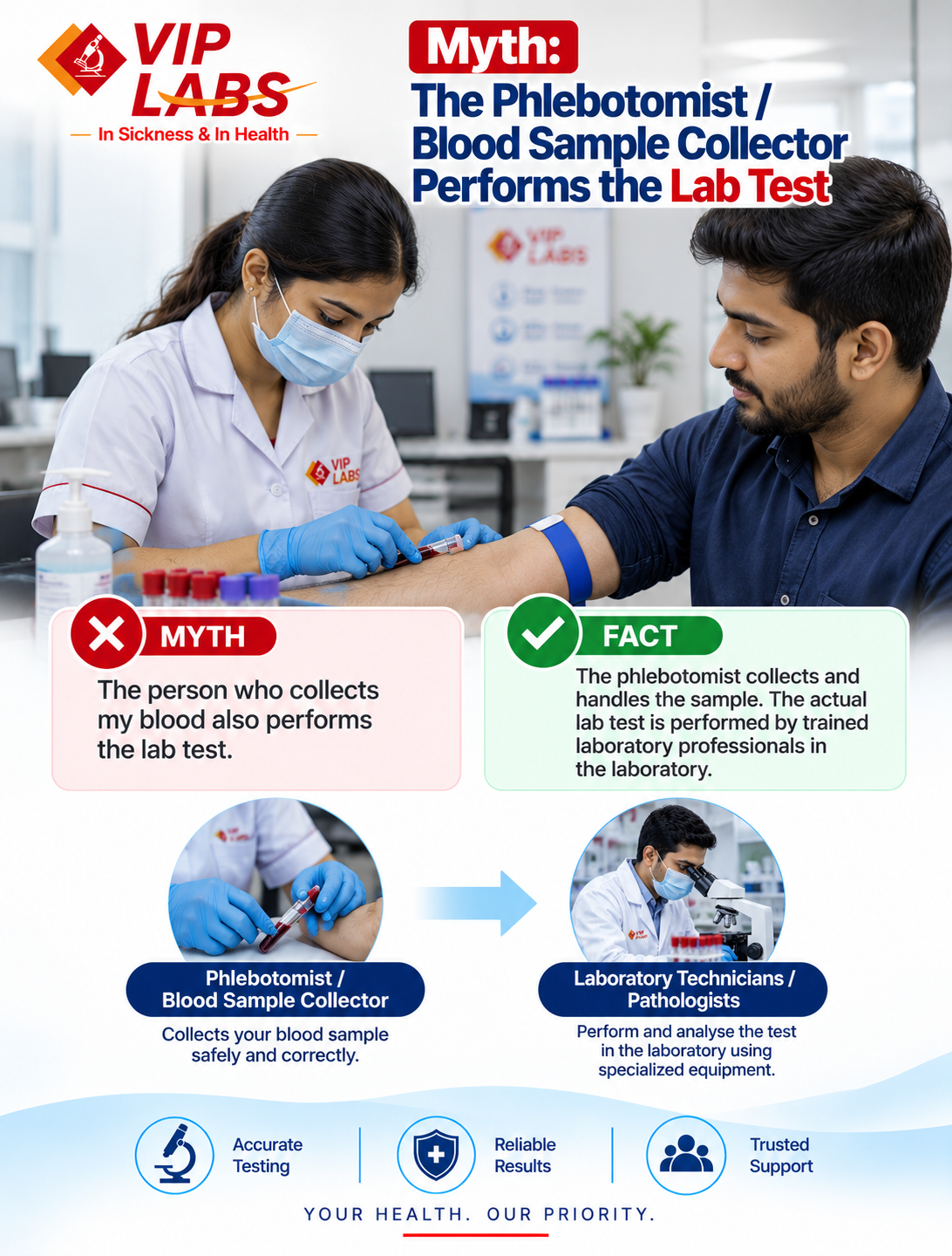
When you visit a diagnostic laboratory for a blood test, the first person you usually meet is the phlebotomist or blood sample collector. They prepare you for the collection, draw your blood, label the sample and make sure it is handled correctly.
Because the same person collects the sample, many people assume that they also perform the actual laboratory test.
This is a common misconception.
In most conventional laboratory testing, sample collection and laboratory testing are two different steps performed by trained professionals with different responsibilities. The phlebotomist focuses on obtaining a suitable specimen, while laboratory professionals process and analyze the sample using appropriate laboratory methods and equipment.
A phlebotomist is trained to collect blood samples safely and correctly.
Their responsibilities may include:
The quality of the sample is important because incorrect collection, labeling or handling can affect the testing process.
VIP Labs provides trained staff for blood sample collection, including convenient home sample collection services in Ahmedabad and Gandhinagar.
Once the blood sample has been collected, it goes through the laboratory's testing and processing workflow.
Depending on the type of test, trained laboratory technicians, technologists and other laboratory professionals may process and analyze the specimen using specialized instruments, methods and quality-control procedures.
For example, a blood sample may be used for:
A pathologist is a medical doctor who specializes in diagnosing disease by examining laboratory specimens and other clinical information.
Depending on the investigation, a pathologist may be involved in reviewing results, interpreting certain laboratory findings, supervising laboratory processes and correlating findings with clinical information.
This is especially important for specialized investigations where professional medical interpretation is required.
So, the complete process involves more than one person and more than one step.
Your blood sample does not simply go from the collection chair directly to a final report.
1. Test is requested
Your doctor recommends the appropriate laboratory investigation based on your symptoms, health condition or monitoring needs.
2. Sample is collected
A trained phlebotomist or blood sample collector collects the required specimen.
3. Sample is identified and prepared
The sample is correctly labeled and handled according to the requirements of the requested test.
4. Sample reaches the laboratory
The specimen is transported or transferred for processing under appropriate conditions.
5. Laboratory testing is performed
The relevant laboratory professionals process and analyze the sample using the appropriate testing method and equipment.
6. Results undergo laboratory review
Depending on the test, results may go through appropriate quality checks and professional review.
7. Report is generated
The laboratory report is released to the patient or healthcare provider.
This separation of responsibilities helps laboratories maintain an organized testing process and quality control.
Even though the phlebotomist does not usually perform the actual laboratory analysis, their role is extremely important.
A blood test begins with a good-quality specimen.
Problems during collection or handling can potentially affect the suitability of a sample for testing. For example, incorrect tube selection, inadequate sample volume, identification errors or improper handling may require a sample to be recollected.
That is why trained sample collectors are an important part of the diagnostic process.
Yes. The person collecting your sample generally needs to know the tests that have been requested because different investigations may require different collection tubes, sample types, quantities or preparation requirements.
However, knowing which test is ordered does not mean that the phlebotomist is performing the laboratory analysis themselves.
Their responsibility is primarily to collect and handle the specimen correctly so that it can be processed by the laboratory.
There can be exceptions.
Some point-of-care tests are designed to provide results close to or at the location where the sample is collected, and appropriately trained personnel may perform them according to the test's procedures.
However, many routine and specialized laboratory investigations require the specimen to be processed and analyzed in a laboratory using dedicated equipment and established procedures.
Therefore, it is important to distinguish between sample collection and laboratory testing.
Laboratory medicine involves multiple stages, and each stage requires specific knowledge and skills.
The process can involve:
Doctor / Healthcare Provider → Phlebotomist → Laboratory Technician/Technologist → Pathologist or Other Qualified Laboratory Professional → Final Report
Each professional contributes to a different part of the diagnostic process.
This teamwork helps ensure that the sample is collected correctly, processed appropriately and reported through the laboratory's established procedures.
Not necessarily.
The person collecting your blood is primarily responsible for the collection process. The laboratory report is generated from the testing performed on the specimen and may involve laboratory professionals and, where appropriate, pathologist review.
Your doctor or healthcare provider then interprets the results together with your symptoms, medical history, examination findings and other relevant investigations.
A laboratory report should therefore not be viewed as something determined by the person who collected the blood alone.
Accurate diagnostic testing depends on the entire testing process—not just the moment when the blood is drawn.
A reliable laboratory should have:
VIP Labs has been providing diagnostic services in Ahmedabad since 1997 and offers routine as well as specialized pathology testing, supported by laboratory infrastructure and experienced professionals.
Yes. Home collection mainly changes where the sample is collected, not the basic laboratory workflow.
A trained phlebotomist can visit your home, collect the required sample, label it appropriately and ensure it enters the laboratory process.
VIP Labs offers home sample collection services, making blood testing more convenient for people who may prefer not to visit a laboratory.
The idea that “the person who takes my blood also performs my lab test” is generally a myth.
The phlebotomist or blood sample collector plays an important role in safely collecting and handling your specimen. The actual laboratory analysis is generally performed by trained laboratory professionals using specialized equipment and procedures, with appropriate professional review depending on the investigation.
So, the next time someone collects your blood at a diagnostic laboratory, remember that sample collection is only the first step of the laboratory testing process.
1. What is a phlebotomist?
A phlebotomist is a trained professional who collects blood samples from patients for laboratory testing. Their responsibilities include proper patient identification, blood collection, labeling and appropriate handling of the specimen.
2. Does a phlebotomist perform the blood test?
Usually, no. The phlebotomist primarily collects the blood sample. The sample is then processed and analyzed by appropriate laboratory professionals using the required laboratory methods and equipment.
3. Who performs blood tests in a laboratory?
Depending on the test, trained laboratory technicians, technologists and other qualified laboratory professionals perform the testing and processing. Some investigations may also involve pathologist review.
4. Does the blood sample go directly to the laboratory after collection?
The sample enters the laboratory workflow after collection. It must be correctly identified, handled and transported or transferred according to the requirements of the particular test.
5. Why is blood sample collection important?
Proper collection helps ensure that the laboratory receives a suitable specimen for analysis. Correct identification, collection technique, tube selection and handling are important parts of the testing process.
6. Can a blood sample collector explain my test results?
A sample collector can generally provide information about the collection process, but interpretation of laboratory results should be done by your doctor or an appropriately qualified healthcare professional.
7. Can blood tests be collected from home?
Yes. Many diagnostic laboratories provide home sample collection through trained staff. VIP Labs offers home sample collection services in Ahmedabad and Gandhinagar, subject to service availability.
8. Are all blood tests performed inside a laboratory?
Not necessarily. Some point-of-care tests can be performed near the patient using specific devices and procedures. However, many routine and specialized investigations require laboratory processing and analysis.
9. Is the phlebotomist an important part of the testing process?
Absolutely. Although sample collection and laboratory analysis are different responsibilities, proper blood collection is an essential first step toward obtaining a reliable laboratory result.
10. Where can I get reliable blood tests in Ahmedabad?
VIP Labs provides a wide range of routine and specialized diagnostic tests through its laboratory network in Ahmedabad and Gandhinagar, along with home sample collection services.
A blood test involves a complete chain of professionals and processes. The phlebotomist collects your sample, while trained laboratory professionals process and analyze it, with appropriate professional review depending on the test.
Understanding this difference helps patients better appreciate the work that goes into producing a laboratory report from the first blood collection to the final result.