
Need Help?
+91 94294 10291
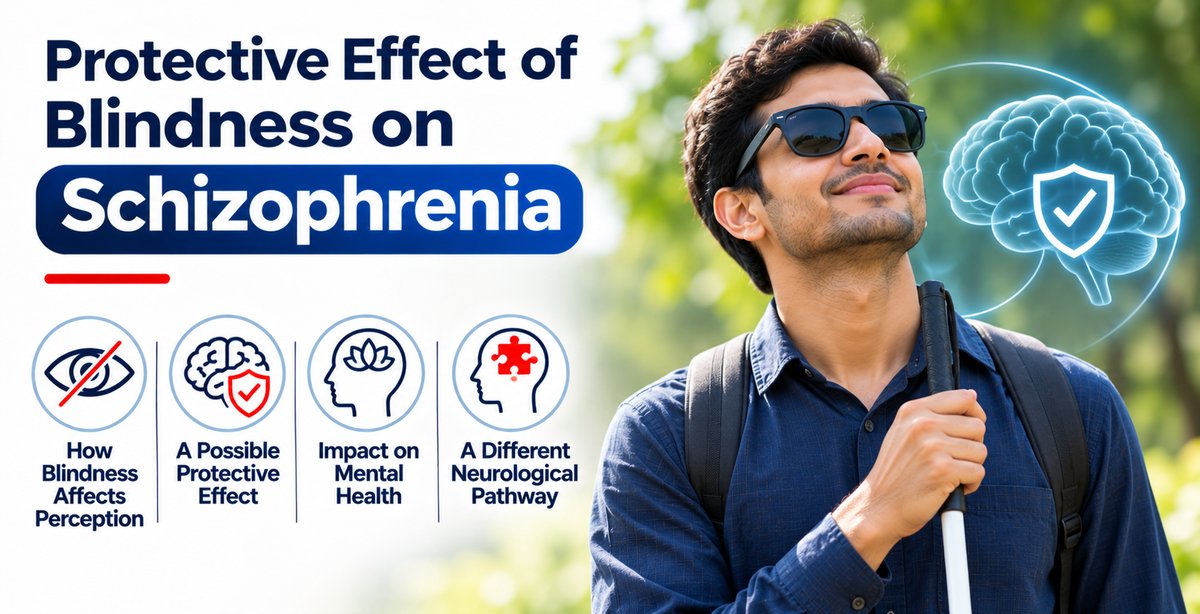
Quick answer: Research on blindness and schizophrenia has found very few, if any, cases of schizophrenia in people born with cortical blindness, leading to the idea that early blindness may be protective. The evidence is observational and based on small numbers, so it is not proven. Schizophrenia is treatable, and early help matters; India's free Tele-MANAS helpline is 14416. See also our guide to anxiety disorders.
The original version of this post described a curious observation: scientists could find no reported cases of schizophrenia in people who were born blind. It is one of the most talked-about puzzles in psychiatry. This updated article explains what the research actually shows, why scientists are cautious, and, most importantly, how to recognise schizophrenia early and get help.
The claim is that congenital or early blindness, meaning blindness present at birth or starting in the first years of life, seems to protect against schizophrenia. People who lose their sight later in life are not protected, and in fact poor vision in adulthood has been linked with a higher risk of psychotic symptoms in some studies.
Interest in blindness and schizophrenia started because, across decades of medical literature, reports of a person who was both born blind and had schizophrenia were extremely rare or absent. Given how common schizophrenia is (it affects roughly 1 in 100 to 1 in 300 people over a lifetime, depending on how it is measured), that absence seemed surprising.
Steven Silverstein and colleagues, then at Rutgers and the University of Medicine and Dentistry of New Jersey, reviewed more than 60 years of literature and reported that they could not find a published case of schizophrenia in a person with congenital or early blindness. They proposed that the brain changes that come with early blindness might strengthen the very mental skills that are weakened in schizophrenia.
The authors themselves noted that absence of evidence is not evidence of absence. A missing case report could simply mean nobody wrote one up.
In 2018, researchers in Western Australia examined health records of nearly half a million people born between 1980 and 2001. Among 66 children with cortical blindness (blindness caused by the brain's visual areas rather than the eyes), none developed schizophrenia or any other psychotic illness.
A 2020 Danish national register study followed people with early blindness and found fewer than five cases of schizophrenia, close to the very small number expected by chance. Both teams concluded the samples were too small to prove or disprove protection; one estimate suggested millions of people would need to be studied to be sure.
The question "can blind people get schizophrenia?" has a clear answer: yes, people who become blind can develop schizophrenia, and a few cases in people blind from early life have been reported. Whether being born with cortical blindness lowers the risk is an interesting but unproven hypothesis. It should not be presented as a fact.
Scientists think about schizophrenia partly as a disorder of perception and thinking, where the brain struggles to make sense of incoming information and predict what comes next. Several ideas try to explain the blindness link:
None of these theories about blindness and schizophrenia has been directly proven. They are best seen as clues that may help understand schizophrenia better, not as practical treatments.
| Source | What it found | Main limitation |
|---|---|---|
| Literature review (Silverstein and colleagues, 2012–2013) | No published case of schizophrenia in congenital or early blindness found over about 60 years | Rare cases may never be written up; not a population count |
| Western Australia records study (2018) | No psychotic illness among 66 people with cortical blindness | Very small group; zero cases could occur by chance |
| Danish register study (2020) | Fewer than five cases, close to the small number expected | Underpowered; exact count not released for privacy |
| Case reports and later reviews | A handful of cases of psychosis in people blind from early life | Individual reports cannot show overall risk |
Schizophrenia is a long-term mental illness that affects how a person thinks, feels, perceives reality and behaves. It usually starts in the late teens to early thirties, often a little earlier in men than in women. It is not "split personality", and most people with schizophrenia are not violent; they are more likely to be victims of violence.
The cause is a mix of genetic risk and environmental factors such as problems before or around birth, heavy cannabis use (especially in teenagers), migration and severe stress. Brain chemicals like dopamine and glutamate are involved.
In India, these symptoms are sometimes mistaken for black magic or spiritual problems, which can delay treatment for years. Early treatment improves outcomes.
Whatever the final answer on blindness and schizophrenia, not every episode of hallucinations or confusion is schizophrenia. Doctors check for other treatable causes, such as:
Get help from a psychiatrist or doctor promptly if you or someone close to you has:
For free, confidential support in many Indian languages, including Gujarati and Hindi, call the Tele-MANAS mental health helpline on 14416 (or 1-800-891-4416). Families can also call to get guidance on how to help a loved one. Our article on beating depression covers mood problems that can overlap.
Schizophrenia is a treatable condition. With early and continued care, many people return to study, work and family life. Treatment usually combines:
Healthy routines help recovery too: regular sleep habits, daily activity and avoiding alcohol and cannabis. See our steps to improve brain health.
There is no blood test for schizophrenia. Diagnosis is made by a psychiatrist through interview and observation. However, when someone has a first episode of psychosis, doctors commonly order tests to rule out physical causes and to get a baseline before medicines:
Your psychiatrist decides which tests are needed. Scans such as MRI and other checks are done in hospital when indicated.
Studies have found very few or no cases of schizophrenia in people born with cortical blindness, which suggests early blindness might be protective. However, the studies are observational and involve small numbers, so the link is an unproven hypothesis rather than an established fact.
Yes. People who lose their sight later in life can develop schizophrenia, and poor vision in adulthood has been linked with a higher risk of psychotic symptoms. A few cases of psychosis have also been reported in people blind from early life.
One theory is that in people born blind, the brain's visual areas are rewired for hearing, touch, language and memory, which may strengthen the thinking skills that are weakened in schizophrenia. This idea has not been proven.
Early signs include withdrawing from family and friends, a drop in work or study performance, unusual suspicion or beliefs, poor sleep, neglect of hygiene and trouble concentrating. If these are followed by hearing voices or fixed false beliefs, see a psychiatrist promptly.
No. Schizophrenia is diagnosed by a psychiatrist through careful assessment. Blood tests such as thyroid function, vitamin B12, CBC, blood sugar and lipid profile are used to rule out physical causes of psychosis and to monitor health during treatment.
Speak to a psychiatrist at a government or private hospital. You can call the free Tele-MANAS mental health helpline on 14416 for confidential support in many Indian languages. In an emergency, such as risk of self-harm, go to the nearest hospital or call 112.
If your psychiatrist has advised a medical work-up or regular monitoring tests, VIP Labs, a trusted pathology lab in Ahmedabad, can help with accurate reports. Find a pathology lab near you, explore health checkup packages, or book online for home sample collection.
Disclaimer: This article is for general awareness only and is not a substitute for medical advice. Please consult a qualified doctor for diagnosis and treatment.