
Need Help?
+91 94294 10291
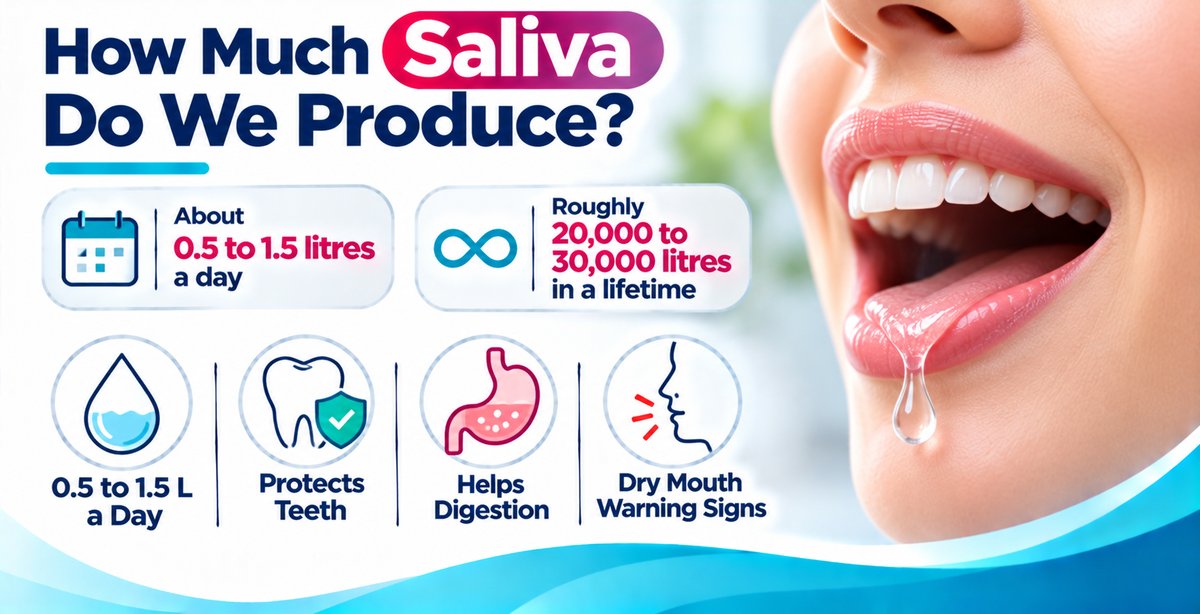
Quick answer: How much saliva do we produce? A healthy adult makes roughly 0.5 to 1.5 litres a day, adding up to around 20,000 to 30,000 litres over a lifetime. Flow is highest while eating and lowest during sleep. A persistently dry mouth can signal diabetes, so a fasting blood sugar test may help.
An old fact card on this blog said we produce about 24,000 litres of saliva in a lifetime, enough to fill two swimming pools. The first half is reasonable; the second half is not. Below we correct the comparison, explain what saliva actually does, and look at the causes of too little or too much saliva.
Most healthy adults produce between half a litre and one and a half litres of saliva every 24 hours. The exact amount varies with age, hydration, diet, medicines and general health.
How much saliva we produce also depends on the time of day, because saliva is not made at a steady rate. There is a low "resting" flow through most of the day that keeps the mouth moist. When you see, smell, think about or chew food, flow rises several-fold. During sleep it drops to very low levels, which is why many people wake with a dry mouth and morning breath.
Three pairs of major salivary glands produce most saliva, helped by hundreds of tiny minor glands in the lips, cheeks and palate:
If you make about 1 litre a day for 70 years, that comes to roughly 25,000 litres. So the original figure of 24,000 litres in a lifetime is plausible, and estimates of 20,000 to 30,000 litres are commonly given.
The "two swimming pools" part, however, is wrong. An Olympic-size pool holds about 2.5 million litres. A lifetime of saliva would fill only about 1% of one Olympic pool, not two. A more honest picture is that it would fill a small backyard pool, or roughly a hundred or more bathtubs.
| Measure | Approximate amount | Notes |
|---|---|---|
| Per day (adult) | 0.5 to 1.5 litres | Higher on eating days with plenty of chewing; lower when dehydrated |
| During sleep | Very low | Explains dry mouth and bad breath on waking |
| While eating | Several times the resting rate | Triggered by taste, smell and chewing |
| In a lifetime | About 20,000 to 30,000 litres | The old 24,000-litre figure fits this range |
| Olympic swimming pool | About 2.5 million litres | A lifetime of saliva fills only about 1% of one pool |
Knowing how much saliva we produce is only half the story; what it does matters more. Saliva is about 99% water, but the remaining small fraction contains enzymes, minerals, proteins and antibodies that do important work:
Because saliva does so much, a fall in production quickly causes tooth decay, gum problems, mouth infections and bad breath.
When people ask how much saliva do we produce, they are often worried about having too little. Feeling a dry mouth is called xerostomia. Occasional dryness from thirst or nervousness is normal. Persistent dryness is worth looking into. Common causes include:
Not drinking enough water, especially in Ahmedabad's hot summers, fever, diarrhoea, vomiting, heavy sweating, alcohol, smoking, too much caffeine and mouth breathing or snoring at night all reduce saliva.
Hundreds of common medicines can reduce saliva, including some for allergies, blood pressure, depression, anxiety, bladder control and pain. Do not stop a prescribed medicine on your own; ask your doctor whether an alternative is possible.
Uncontrolled diabetes causes frequent urination and fluid loss, leading to dry mouth and constant thirst. Dry mouth with increased thirst, frequent urination, tiredness or weight loss is a reason to get blood sugar checked.
In Sjogren's syndrome, the immune system attacks the glands that make saliva and tears, causing dry mouth with dry, gritty eyes. It is more common in women and can occur with rheumatoid arthritis or lupus. Read more about autoimmune diseases.
Ageing (often due to more medicines rather than age itself), radiation treatment to the head and neck, salivary gland stones or infections, kidney disease, thyroid problems and anxiety can also cause a dry mouth.
Producing or noticing excess saliva (hypersalivation) is less common. It can occur with teething in babies, pregnancy, acid reflux, mouth ulcers or infections, new dentures, certain medicines, and neurological conditions that affect swallowing, such as Parkinson's disease or stroke. Drooling during sleep is usually harmless.
See a doctor or dentist if you have:
A dentist or doctor examines your mouth and glands and may measure saliva flow. Blood and urine tests do not measure how much saliva you produce, but they help find underlying causes:
Not sure where to start? Our diabetes test guide for Ahmedabad explains preparation, and the comprehensive metabolic panel covers sugar, kidney and electrolyte markers together.
A healthy adult produces about 0.5 to 1.5 litres of saliva a day. Flow is highest while eating and very low during sleep. Dehydration, medicines and some illnesses reduce it.
Roughly 20,000 to 30,000 litres over a lifetime. That is often described as enough to fill two swimming pools, but it would fill only about 1% of one Olympic-size pool.
Saliva starts starch digestion, helps you chew, swallow and taste, neutralises acids, helps repair tooth enamel, and contains antibodies that control mouth germs. It also keeps the mouth moist for speaking.
Saliva flow naturally drops during sleep. Mouth breathing, snoring, a blocked nose, air conditioning, alcohol and some medicines make it worse. If dryness persists during the day too, see a doctor to rule out diabetes or other causes.
It can be. Uncontrolled diabetes causes frequent urination and fluid loss, leading to dry mouth and thirst. A fasting blood sugar or HbA1c test can check for diabetes, but dry mouth has many other causes too.
Drink water regularly, chew sugar-free gum, suck sugar-free lozenges, and limit caffeine, alcohol and tobacco. If a medicine is causing dryness, ask your doctor about alternatives rather than stopping it yourself.
If a dry mouth keeps bothering you, a few simple tests can rule out common causes like diabetes and dehydration. VIP Labs offers sugar, HbA1c, kidney and electrolyte tests; book a blood test in Ahmedabad with home sample collection booked online, or search for a lab test near me to find the closest VIP Labs centre.
Disclaimer: This article is for general awareness only and is not a substitute for medical advice. Please consult a qualified doctor for diagnosis and treatment.