
Need Help?
+91 94294 10291
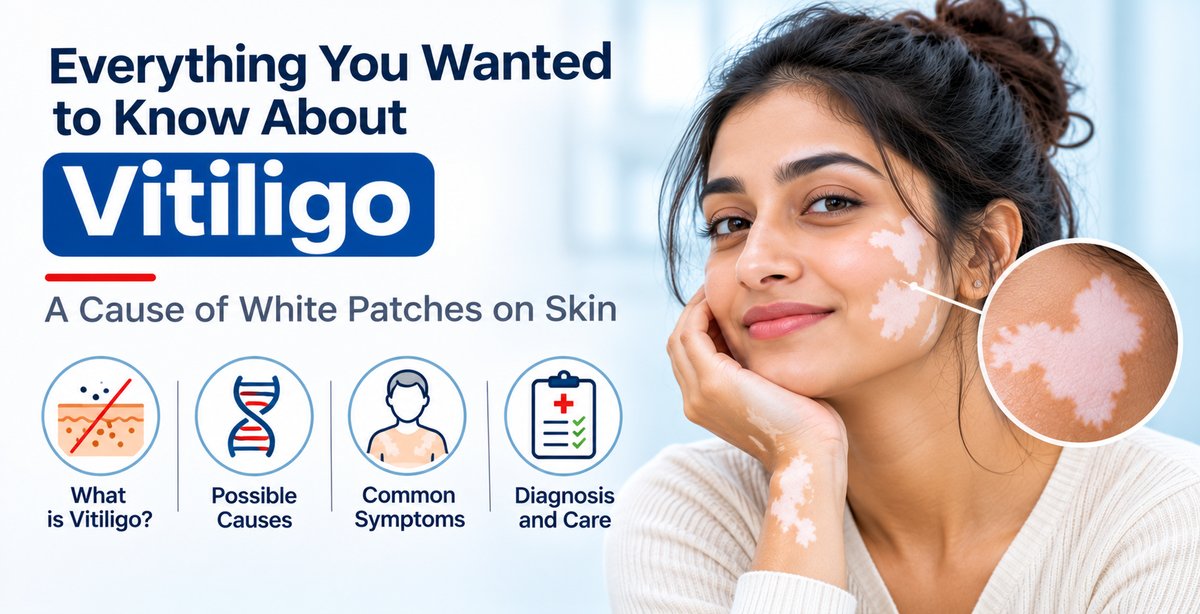
Quick answer: Vitiligo causes and treatment in brief: vitiligo is an autoimmune condition in which the immune system destroys pigment cells, leaving milky-white patches on the skin. It is not contagious and not caused by food. Creams, phototherapy and newer JAK-inhibitor creams can restore colour in many people. Because it is linked to thyroid disease, doctors often advise a thyroid function test.
Finding a white patch on your skin can be worrying, and in India vitiligo (often called safed daag or leucoderma) still carries a lot of stigma and myths. This guide explains vitiligo causes and treatment clearly: what it is, why it happens, how it differs from other white patches, which tests help and what treatment can realistically achieve.
Vitiligo is a long-term skin condition in which melanocytes, the cells that make the pigment melanin, stop working or are destroyed. Without melanin, the affected skin turns chalk-white or milky-white. Hair growing in the patch can also turn white.
It affects roughly 0.5 to 2 percent of people worldwide, in all skin types, though patches are more visible on brown skin. It can start at any age, but about half of people notice it before the age of 20. It is not painful and not infectious.
Vitiligo is mainly an autoimmune condition. The body's own immune cells attack and destroy melanocytes.
Immune cells called T cells, driven by signalling molecules such as interferon-gamma, target the pigment cells. This is why vitiligo often appears with other autoimmune diseases, especially thyroid disease.
Vitiligo runs in some families. Having a parent or sibling with vitiligo raises your chance, but most children of a parent with vitiligo never develop it. It is not simply inherited from one gene.
In people who are already prone, patches may first appear or spread after a sunburn, a cut or friction on the skin (called the Koebner phenomenon), severe emotional stress, or contact with certain chemicals. Chemical leukoderma can follow repeated contact with some adhesives in bindis, rubber footwear or hair dyes.
Vitiligo is not caused by eating fish with milk, sour foods or white foods. It is not a form of leprosy, it is not a sign of poor hygiene, and it does not spread by touch, sharing food or sharing clothes.
This is the most common type. Patches usually appear on both sides of the body in a roughly matching pattern. It tends to come and go in phases over years.
Patches appear on one side or one area of the body, usually start in childhood, spread for a year or two and then often stop. It is less often linked to other autoimmune diseases.
Vitiligo can spread on your own body, but it never spreads to other people. The course is unpredictable. Some patches stay the same for years, some spread slowly, and some regain colour on their own.
New patches, blurred or confetti-like edges and patches at injury sites suggest active disease. In vitiligo causes and treatment planning, this matters: treatment works best before patches have been white for a long time.
Not every white patch is vitiligo. Several common skin conditions look similar, and some need very different treatment, so a dermatologist should confirm the diagnosis.
| Condition | How it usually looks | Key clue |
|---|---|---|
| Vitiligo | Milky or chalk-white patches with sharp edges | Complete pigment loss; bright under a Wood's lamp |
| Tinea (pityriasis) versicolor | Light or pinkish patches on chest, back, neck | Fine scale, worse in heat and sweat; a fungal infection treated with antifungals |
| Pityriasis alba | Pale, slightly dry patches on cheeks of children | Linked to dry skin and eczema; fades over time |
| Post-inflammatory hypopigmentation | Lighter skin after a rash, burn or injury | Follows a previous skin problem; usually improves |
| Leprosy (Hansen's disease) | Pale or coppery patches | Reduced feeling of touch or temperature in the patch; curable with treatment, needs a doctor |
A dermatologist usually diagnoses vitiligo by examining the skin. A Wood's lamp (ultraviolet light) makes depigmented patches glow bright white and helps spot patches that are hard to see. A biopsy or fungal scraping is needed only when the diagnosis is unclear.
No blood test diagnoses vitiligo. Blood tests are used to check for conditions that occur more often alongside it, so they can be treated early. Your doctor may suggest:
You can see the full range of blood tests in Ahmedabad on our test menu. See our thyroid test guide.
Older articles, including the earlier version of this post, said vitiligo is simply "not curable". The more accurate answer today: there is no permanent cure that guarantees it will never return, but many people regain a lot of colour with treatment, and the outlook has improved in recent years. Results are best on the face and neck, and slowest on hands, feet and lips.
Topical corticosteroids and calcineurin inhibitors (tacrolimus or pimecrolimus) calm the immune attack and can repigment small or early patches. They must be used exactly as a dermatologist directs, since strong steroids can thin the skin.
Ruxolitinib cream became the first treatment specifically approved for non-segmental vitiligo in the US in 2022, and is approved in Europe as well. It blocks an immune signalling pathway that drives pigment loss. Oral JAK inhibitors are being studied. These are prescription medicines and need specialist supervision.
Narrowband UVB light therapy, given two or three times a week in a clinic, is one of the most effective options for widespread or spreading vitiligo. Targeted excimer light can treat small patches. It usually takes several months to see results.
When vitiligo is spreading fast, a dermatologist may add a short course of oral medicine to calm the disease.
For stable vitiligo (no new patches for about a year), skin or cell grafting can move pigment cells into white areas. Cosmetic camouflage creams help some people.
Avoid "guaranteed cure" offers and treatments that burn the skin; they can scar and worsen patches.
See a dermatologist for any new white patch so the cause is confirmed. Seek medical advice promptly if:
No. Vitiligo is an autoimmune condition, not an infection. It cannot spread from one person to another through touch, food, clothes, kissing or sharing utensils.
There is no treatment that guarantees vitiligo will never come back, but it is not untreatable. Creams, JAK-inhibitor cream, phototherapy and grafting can restore colour in many people, especially on the face and neck. Early treatment by a dermatologist gives the best results.
The main cause is an autoimmune attack on melanocytes, the skin's pigment cells. Genes increase the risk, and triggers such as sunburn, skin injury, stress or certain chemicals may start or worsen patches in people who are already prone.
Vitiligo is not caused by a vitamin deficiency. However, low vitamin B12 is seen more often in people with vitiligo, and white patches can also be due to fungal infection, dry skin or other conditions. A dermatologist can confirm the cause and advise tests such as vitamin B12, thyroid and CBC.
No. This is a common myth in India. No food or food combination causes vitiligo, and avoiding fish, milk, sour or white foods does not prevent or treat it.
No blood test diagnoses vitiligo, which is diagnosed by examining the skin. Doctors often advise thyroid tests such as TSH, a CBC, vitamin B12 and blood sugar to look for associated conditions like autoimmune thyroid disease, pernicious anaemia and diabetes.
If you have vitiligo or your dermatologist has advised screening, VIP Labs, a trusted pathology lab in Ahmedabad, offers thyroid, vitamin B12, CBC, blood sugar and vitamin D tests, as well as health checkup packages that combine them. Book home blood collection in Ahmedabad or visit a VIP Labs centre near you; reports are shared online. Understanding vitiligo causes and treatment, and checking for linked conditions, helps you and your doctor plan care with confidence.
Disclaimer: This article is for general awareness only and is not a substitute for medical advice. Please consult a qualified doctor for diagnosis and treatment.