
Need Help?
+91 94294 10291
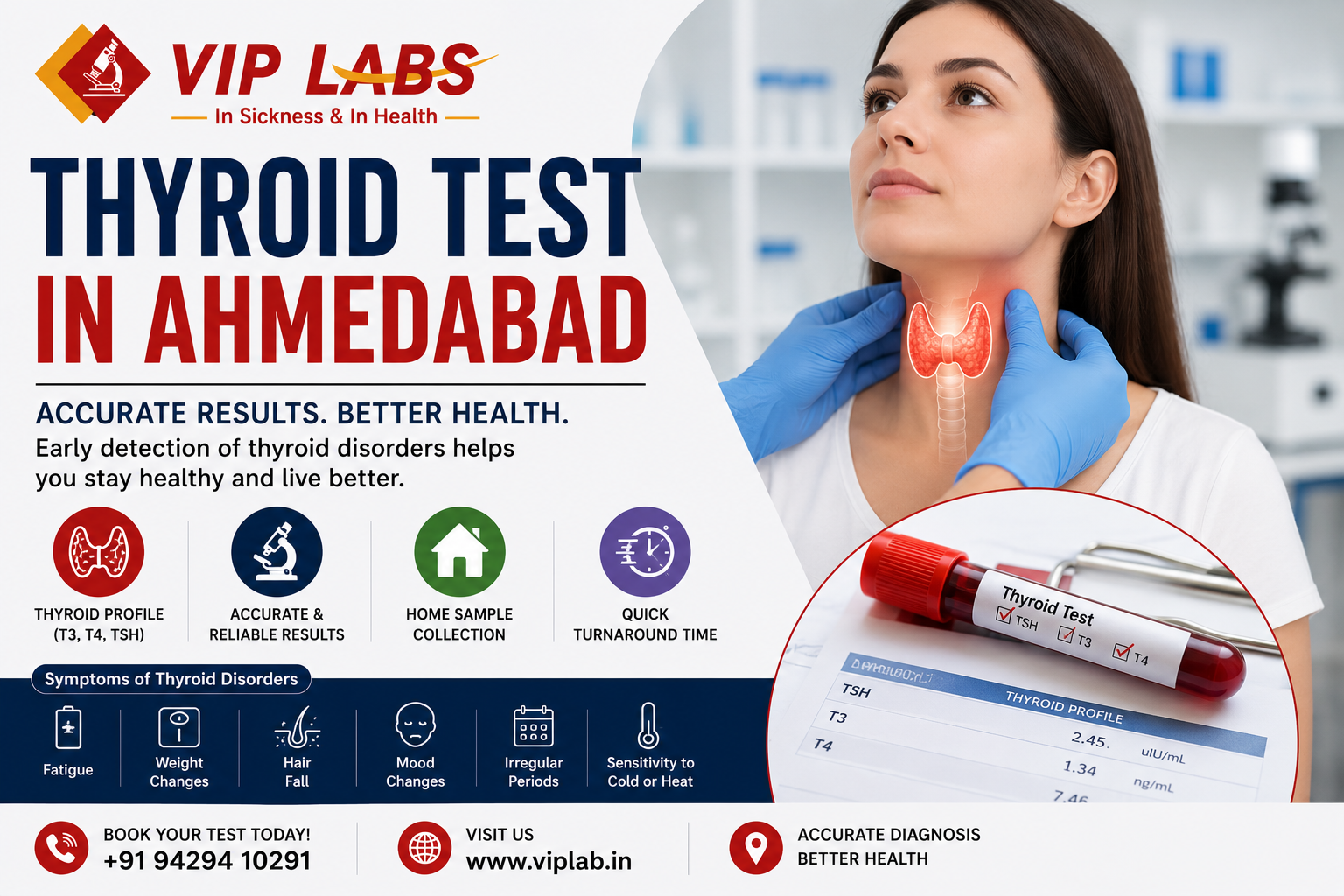
Quick answer: A thyroid test in Ahmedabad is a simple blood test that measures TSH, T3 and T4 to check whether your thyroid is underactive or overactive. No fasting is usually needed. At VIP Labs you can book a thyroid profile (T3, T4, TSH) at 20+ centres or with home sample collection, with same-day reports for routine tests.
Tiredness, weight changes, hair fall, irregular periods or a racing heart can all point to the thyroid, but they have many other causes too. A blood test is the only reliable way to know. This guide explains which thyroid test to ask for, how to prepare, what normal TSH and abnormal patterns look like, the cost of a thyroid test in Ahmedabad and how to book one with VIP Labs, a pathology lab serving the city since 1997.
The thyroid is a small butterfly-shaped gland in the front of the neck. It makes two hormones, T4 (thyroxine) and T3 (triiodothyronine), which control how fast your body uses energy. The pituitary gland in the brain releases TSH (thyroid-stimulating hormone) to tell the thyroid how much hormone to make.
A thyroid test, also called a thyroid function test (TFT) or thyroid profile, measures these hormones in a small blood sample. When the thyroid is slow, the pituitary pushes harder and TSH rises. When the thyroid is overactive, TSH falls. This is why TSH is the most sensitive first test, and T3 and T4 show how severe the problem is.
Your doctor will choose the test based on your symptoms and history. The table below summarises the common thyroid blood tests and when each is used.
| Test | What it measures | When it is used |
|---|---|---|
| TSH | Pituitary signal to the thyroid | First screening test; monitoring thyroid tablets |
| Total T4 | All thyroxine in blood (bound and free) | Confirms hypo- or hyperthyroidism when TSH is abnormal |
| Total T3 | All triiodothyronine in blood | Mainly for suspected overactive thyroid |
| Thyroid profile (T3, T4, TSH) | All three together | Most common package for symptoms or check-ups |
| Free T3 / free T4 | Unbound, active hormone | Pregnancy, certain medicines, or when total values are misleading |
| Anti-TPO antibodies | Antibodies against the thyroid | Finds autoimmune thyroiditis (Hashimoto's), a common cause of hypothyroidism |
At VIP Labs you can book a single TSH test, a total T3 test, a total T4 test or the combined thyroid profile. Ask the centre about free T4 and antibody tests if your doctor has requested them.
Thyroid problems often develop slowly, so many people get used to the symptoms. Women are affected far more often than men, and the risk rises after pregnancy and with age.
Doctors commonly advise a thyroid test for women planning pregnancy or in early pregnancy, people with a family history of thyroid disease, those with type 1 diabetes or other autoimmune conditions, women with PCOS or infertility, anyone with a goitre (neck swelling), and people on medicines such as lithium or amiodarone. Many full body check-ups also include TSH as part of routine screening.
Preparation is simple, but a few points make your result more reliable:
For other tests, read our guide on whether fasting is required for every blood test.
Each lab prints its own reference range, and that range is the one to use. For most adults, TSH is broadly normal at about 0.4–4.0 mIU/L (some labs go up to around 4.5). T3 and T4 ranges differ more between methods, so always compare with the range on your report rather than a number from the internet.
| TSH result | T4 / T3 result | What it usually suggests |
|---|---|---|
| High | Low T4 | Hypothyroidism (underactive thyroid) |
| Mildly high | Normal T4 | Subclinical hypothyroidism – often rechecked in 6–12 weeks |
| Low | High T4 and/or T3 | Hyperthyroidism (overactive thyroid) |
| Low | Normal T4 and T3 | Subclinical hyperthyroidism, or effect of illness or medicines |
| Low or normal | Low T4 | Uncommon; may be a pituitary problem or a recent illness – needs a doctor's review |
A single slightly abnormal value is not a diagnosis. Illness, recovery from illness, pregnancy and some medicines can shift results. Pregnancy uses separate, lower TSH targets, so pregnant women should have results read by their gynaecologist. This is why borderline results are often repeated after a few weeks before any treatment is started.
The cost of a thyroid test in Ahmedabad depends on what is tested: a single TSH costs less than a full T3, T4, TSH profile, and free hormone or antibody tests cost more. Prices also change from time to time, so check the current rate on the blood test price list or call VIP Labs on +91 94294 10291 before booking.
If you also want sugar, cholesterol, liver and kidney checks, a package is often better value than single tests. These are the Fit India packages listed at the time of writing:
| Package | Tests | Price (at the time of writing) |
|---|---|---|
| Fit India Mini Body Profile | 66 | ₹999 |
| Fit India Basic Body Profile | 76 | ₹1,399 |
| Fit India Essential Body Profile | 97 | ₹2,099 |
| Fit India Advance Body Profile | 109 | ₹3,199 |
Open each package page to confirm whether thyroid tests are included before you book. Women with irregular periods should ask their doctor whether a PCOD panel should be added to the thyroid test. Regular testers can save with the Fit India Club health checkup membership, which gives up to 50% off tests through discounts and wallet points.
A thyroid test needs only a few millilitres of blood, so it is ideal for home collection. VIP Labs offers free home sample collection across Ahmedabad and Gandhinagar when the test value is above ₹500. This suits senior citizens, people on long-term thyroid medicine who test every few months, busy professionals and pregnant women. You can book home blood collection in Ahmedabad online and choose a convenient slot.
Learn more about what makes a trusted pathology lab in Ahmedabad in our guide to choosing a blood test lab.
Walk in at centres including Bodakdev, Bopal, Gota, Shahibaug, Nikol and Kudasan (Gandhinagar). Other centres include Prernatirth, South Bopal, Shela, Shilaj, Makarba, Sanand, Motera, New Ranip, New Chandkheda, Meghaninagar, Asarva, Narol, New Vasna, Nana Chiloda, Bhadaj and Sargasan. See the full list to find a pathology lab near you.
Book a doctor's visit if your TSH, T3 or T4 is outside the reference range, or if symptoms continue even with a normal report. Seek urgent medical care if you notice:
Hypothyroidism is usually treated with a daily thyroid hormone tablet, and TSH is rechecked about 6–8 weeks after any dose change, then every 6–12 months once stable. Hyperthyroidism may be treated with anti-thyroid medicines, radioactive iodine or surgery, with more frequent tests early on. Your doctor sets the dose and schedule. Since autoimmune thyroid disease is common, our article on autoimmune disease symptoms and tests is also useful. Eating iodised salt, avoiding self-medication and testing on schedule are the simplest ways to stay on track.
No. TSH, T3 and T4 do not need fasting. An early-morning sample is preferred, and if fasting tests like sugar or lipids are taken in the same sample, follow their fasting instructions.
For most adults, TSH is broadly normal at about 0.4 to 4.0 mIU/L, though each lab prints its own range. Pregnancy uses lower targets, so always read the result with your doctor.
TSH is the best first test because it changes early. If TSH is abnormal, T4 and T3 show how severe the problem is, and anti-TPO antibodies can show whether it is autoimmune.
Many doctors advise giving the blood sample first and taking the tablet afterwards on the test day, so the result reflects your steady level. Follow your own doctor's instructions and do not stop the medicine.
The cost depends on whether you need TSH alone or a full T3, T4, TSH profile, and prices change over time. Check the current price on the VIP Labs tests page or call +91 94294 10291.
Yes. VIP Labs collects blood samples at home across Ahmedabad and Gandhinagar, free of charge when the test value is above 500 rupees. You can book online or by phone.
Whether you need a first thyroid test in Ahmedabad or regular TSH monitoring, VIP Labs makes it easy with 20+ centres, free home collection above ₹500 and same-day reports for routine tests. Add other checks through our health checkup packages, or contact our team with any question about preparation or reports.
Disclaimer: This article is for general awareness only and is not a substitute for medical advice. Please consult a qualified doctor for diagnosis and treatment.