
Need Help?
+91 94294 10291
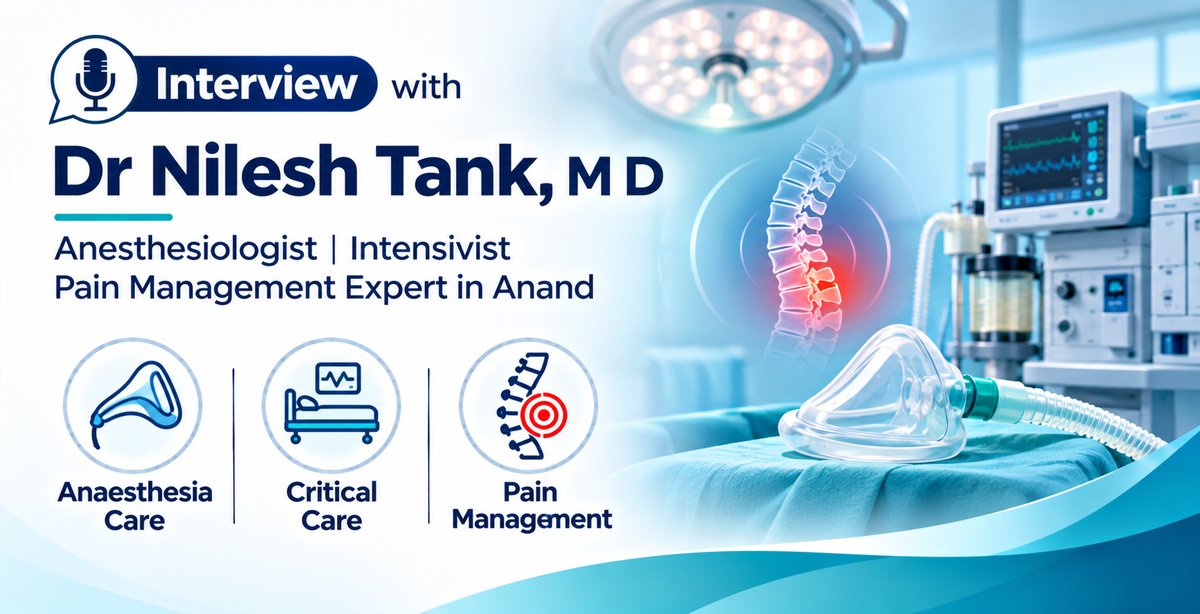
Quick answer: Dr Nilesh Tank is a pain management specialist, MD anaesthesiologist and intensivist from Anand, Gujarat, practising since 2000. At the time of this interview he owned Anand Spinetics, a pain management centre. He shares views on evidence-based care, safe anaesthesia, digital records and healthy living, including avoiding unnecessary repeat tests.
Anaesthesiologists keep patients safe during surgery, look after critically ill patients and, increasingly, help people living with long-term pain. In this online interview, Dr Tank talks about what good practice looks like, gaps in anaesthesia care and how technology can help. Below is our summary, followed by the full interview in his own words.
At the time of the interview, Dr Nilesh Tank was an MD anaesthesiologist, intensivist and pain management expert who had been in practice since 2000. He was the owner of Anand Spinetics, a pain management centre in Anand, Gujarat.
| Detail | At the time of the interview |
|---|---|
| Name | Dr Nilesh Tank |
| Qualification | MD (Anaesthesiology) |
| Specialty | Anaesthesiology, intensive care, pain management |
| In practice since | 2000 |
| Organisation | Owner, Anand Spinetics pain management centre |
| Location | Anand, Gujarat |
An anaesthesiologist (anesthesiologist in US spelling) is a doctor who plans and gives anaesthesia, monitors breathing, heart rate and blood pressure during surgery, and manages recovery afterwards. Many also work as intensivists in ICUs, and some train further as a pain management specialist.
Pain medicine looks after people with long-standing pain such as back and neck pain, sciatica, joint pain, nerve pain and cancer-related pain. Treatment usually combines medicines, physiotherapy, lifestyle change and, where suitable, image-guided procedures such as nerve blocks or injections. The goal is better function and quality of life, not only a lower pain score.
Before planned surgery, the team reviews your health history, medicines and allergies, and may order tests such as a CBC test, blood sugar, kidney function test, serum electrolytes and blood group. The exact list depends on your age, health and the type of surgery. Keeping your earlier reports handy – on paper or digitally – helps avoid repeating tests without need.
I believe that the basic pillars of success for any health care professional are through theory knowledge, proper practical application and evidence based Practice. Unless you have sufficient theoritical knowledge, you cannot develop the eyes that can see facts, you are wondering blindly while you try to diagnose and treat the patient.
Once you acquire theoritical knowledge second important aspect is the skill to apply the knowledge in practice. I have seen a lot of professionals with sound theoritical knowledge, who simple are not that good practitioners, just because they lack the knowhow to apply their insight, clinically.
And finally, 'Evidence Based Practice' is the essence of successful and effective clinical practice.
My advice to my fellow professionals is to work for proper care of the patients, but not after Care of finance (Money). When "caring for money" becomes your prime focus, you loose focus of your own health, family and social life. And then starts the problems.
So keep caring for the patients, but don't forget to care for your self and your health.
If I talk of my specialty, poor setup for anesthesia and post-anesthesia care are what troubles me the most in my practice. A lot of money is spent on other trival aspects in hospitals, nursing homes and institutes; but the essential infrastructure and technology required for anesthesia is frequently compromised.
In the same manner though 'post-anesthesia-care' is as equal as the intra-operative management, frequently it is the least thought of aspect. We should learn to provide the same quality of care and concern for this also.
In my view, 'effective communication' with the patients and their relatives regarding the disease and its best available & best possible treatment options, can decrease to a great extent the friction health care professionals face when the expections of the patients and the possible outcome do not match.
The time a healthcare professional spends in discussing and satisfying all the questions and concerns of patients in the initial consultations and before the treatment is started, is well spent. Never try to save this time. It can get you into bed times very frequently.
For the field of Anesthesia, I have not seen much useful mobile applications that can help us to record patient's data easily and we can use it for essy access when I need it. I would love to have such an application. I see a great future for the Virtual and telemedicine fields.
An anesthetist's live would be certainly be improved by such an app customized for us.
I personally always stress on three things : Eat, Drink and sleep "Healthy" and the Exercise comes next.
I specifically use the word 'healthy', because most of the illnesses and health issues we see today, are because of the unhealthy food habits, unhealthy drinking habits which includes various addictions and finally the irregular sleeping habits. If people are properly taught and made aware about the 'healthy' eating, drinking and sleeping habits, there would be drastic improvement in their health.
Digital revolution would help people to organize their health care records properly and would prevent a lot of over testing and missed information we see today, just because of the lack of documentation.
But certainly yes, it would be necessary to maintain proper security of the data, as it is very sensitive.
From the perspective of an anesthetist, proper, detailed pre-operative assessment is of highest priority and the anesthesiologist needs to specifically stress on this important aspect.
Second priority is 'optimization of the present physical status' of the patient whenever it is possible.
For me Honesty is the Best Policy. If we are successful in generating an Honest environment where in all health-care professionals work together, a very healthy feeling of trust would develop and would help everyone involved with the field of health-care.
Beside my field, i.e. Anesthesiology, critical care and pain management, I am very much interested in music, travelling and the digital media. I love to explore music, land and the net.
Dr. Nilesh Tank, M.D. (Consultant Anesthetist,
Critical Care & Pain Management Expert)
Anand Spinetics Pain Managment Clinic,
RS Platinum Building, Opp Jade Blue,
Anand Bhalej Road, Anand, Gujarat 388001
drnileshtank2002@yahoo.co.in Phone: 02692 243370
A pain management specialist is a doctor, often an anaesthesiologist with extra training, who diagnoses and treats long-term or difficult pain. They use a mix of medicines, physiotherapy advice, lifestyle changes and procedures such as nerve blocks or injections. The aim is to reduce pain and help you move and function better.
An anaesthesiologist assesses you before surgery, chooses and gives the right type of anaesthesia, and watches your breathing, heart and blood pressure throughout the operation. They also manage pain and recovery afterwards. Many anaesthesiologists work in intensive care units and pain clinics as well.
Consider seeing one if pain lasts more than about three months, keeps returning, disturbs sleep or work, or does not improve with your family doctor's treatment. Sudden severe pain, pain with fever, weakness, numbness or loss of bladder or bowel control needs urgent medical care rather than waiting for an appointment.
Pre-operative assessment helps the team spot problems such as uncontrolled diabetes, anaemia, high blood pressure, heart or kidney issues and medicine interactions before surgery. Fixing or planning for these reduces the risk of complications during anaesthesia. Always tell the team about all medicines, supplements and allergies.
Common pre-operative tests include a complete blood count, blood sugar, kidney function, electrolytes and blood group, with others such as clotting tests or an ECG when needed. The exact list depends on your age, health conditions and the type of surgery. Your surgeon or anaesthesiologist will decide what is necessary.
If your doctor has advised tests before a procedure or a routine check, VIP Labs is a best pathology lab in Ahmedabad option with clear, timely reports. Explore our health checkup packages, find a lab test near me or book online for home sample collection.
Disclaimer: This article is for general awareness only and is not a substitute for medical advice. Please consult a qualified doctor for diagnosis and treatment.