
Need Help?
+91 94294 10291
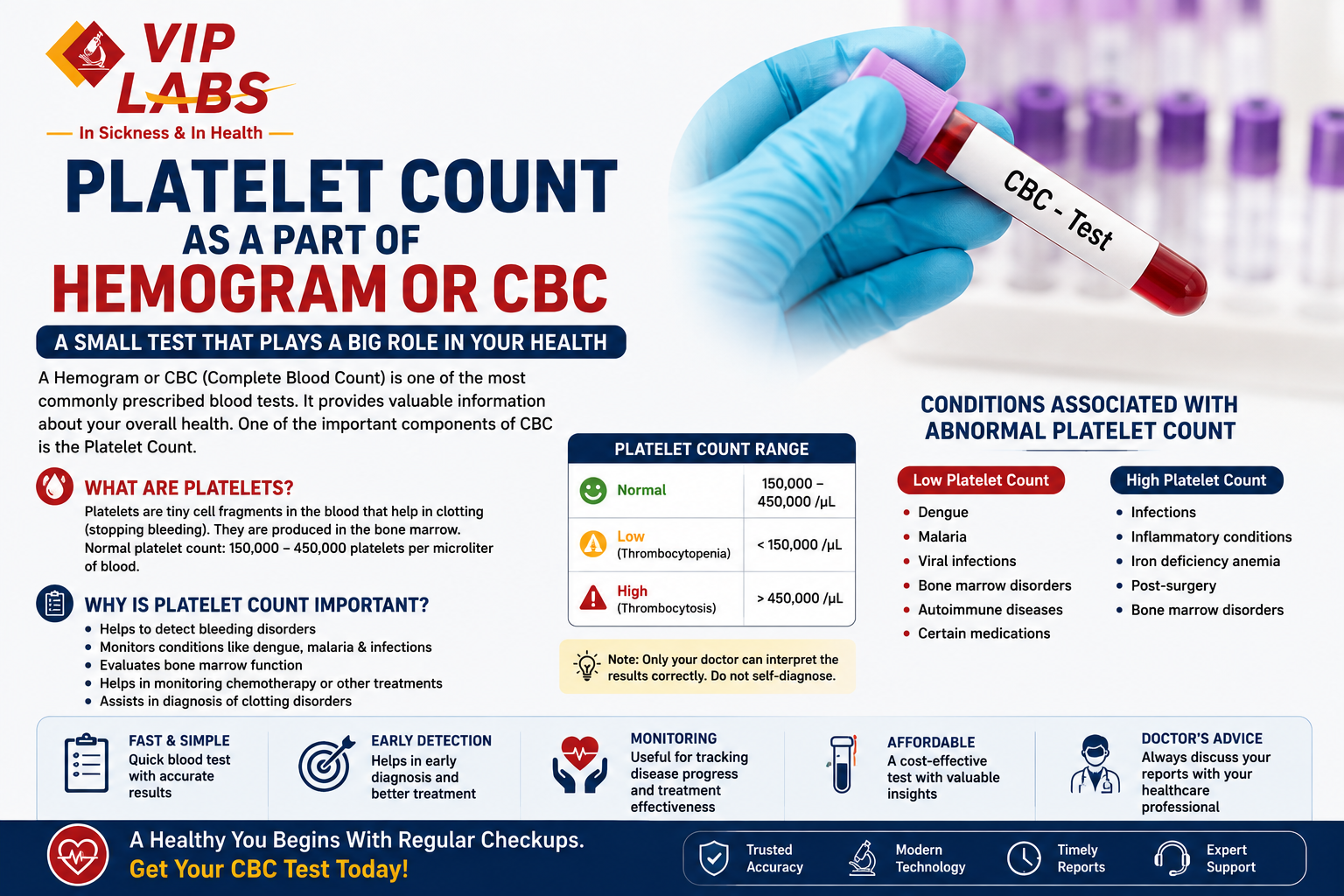
A Complete Blood Count (CBC), also known as a Hemogram, is one of the mo.st commonly performed blood tests. It provides important information about different types of blood cells, including red blood cells, white blood cells, hemoglobin and platelets.
The Platelet Count is an important component of a CBC because platelets play a key role in blood clotting. Understanding your platelet count can help healthcare professionals evaluate certain bleeding or clotting problems and monitor various health conditions.
Platelets, also called thrombocytes, are small cell fragments produced in the bone marrow. When a blood vessel is injured, platelets gather at the site and work with clotting proteins to help form a blood clot and stop bleeding.
The platelet count reported in a CBC tells you how many platelets are present in a specific amount of blood. It is commonly reported as platelets per microliter (µL).
A platelet count is the specific part of a CBC that measures the number of platelets in your blood. A CBC also evaluates other blood components, including red blood cells, white blood cells, hemoglobin, hematocrit, and red blood cell indices.
On a laboratory report, platelet count may be shown as:
PLT – Platelet Count
The CBC may also include MPV (Mean Platelet Volume), which provides information about the average size of your platelets.
For adults, a commonly used reference range is approximately:
150,000 to 400,000 platelets per microliter (µL) of blood.
However, reference ranges can vary slightly between laboratories. Therefore, it is important to compare your result with the reference range printed on your laboratory report.
A platelet count outside the reference range does not automatically mean that you have a serious disease. Your doctor will interpret the result along with your symptoms, medical history, medications and other blood test results.
A platelet count below the laboratory's normal range is known as thrombocytopenia. Low platelets may increase the tendency to bleed, although the symptoms and level of risk depend on how low the count is and what is causing it.
Possible causes of a low platelet count can include:
A low platelet count should be evaluated by a healthcare professional rather than interpreted on its own.
Some people with mildly reduced platelet counts may have no symptoms. Depending on the severity and cause, possible signs can include:
If you experience unusual or persistent bleeding, consult a healthcare professional promptly.
A platelet count above the normal range is called thrombocytosis. A high platelet count can occur temporarily as a response to conditions such as infection, inflammation, or recent surgery. In some cases, it can be related to an underlying blood or bone marrow disorder.
Possible causes may include:
A high platelet count does not always mean that a person will develop a blood clot. The significance depends on the underlying cause and the overall clinical picture.
The platelet count can provide valuable information when doctors are evaluating blood-related conditions.
A CBC with platelet count may help healthcare professionals:
A CBC is only one part of medical evaluation. Abnormal results usually need to be interpreted alongside symptoms, medical history, and other investigations.
Platelet count is often monitored in people with dengue fever, particularly when symptoms and clinical findings suggest the need for monitoring.
However, a low platelet count is not specific to dengue. Many other infections and medical conditions can cause thrombocytopenia.
Therefore, dengue should not be diagnosed based on platelet count alone. A doctor may recommend appropriate dengue-specific tests along with a CBC depending on the patient's symptoms and stage of illness.
A platelet count is usually obtained through a standard blood sample.
A healthcare professional collects a small amount of blood from a vein, generally from the arm. The sample is then analyzed in the laboratory using automated blood-count equipment.
A CBC generally does not require special preparation. However, if your doctor has ordered additional tests along with the CBC, fasting or other preparation may sometimes be required. Follow the instructions provided by your healthcare professional or laboratory.
An abnormal platelet count should not be interpreted in isolation.
Your doctor may consider:
In some cases, your doctor may recommend repeating the CBC or performing a peripheral blood smear to examine blood cells and platelets under a microscope.
A platelet count and platelet function test are not the same.
A platelet count measures how many platelets are present in your blood.
A platelet function test evaluates how well platelets work to form clots. Specialized platelet function tests may be recommended when a doctor suspects a platelet function disorder despite an appropriate platelet count.
The platelet count is an important part of a Hemogram or Complete Blood Count (CBC). Since platelets play a vital role in blood clotting, their number can provide useful information when evaluating bleeding, clotting, infections, and other health conditions.
If your platelet count is higher or lower than the laboratory reference range, do not panic or self-diagnose. Discuss the result with your healthcare professional, who can interpret it in the context of your overall health.
For routine health monitoring or when recommended by your doctor, a CBC test with platelet count can provide valuable information about your blood health